
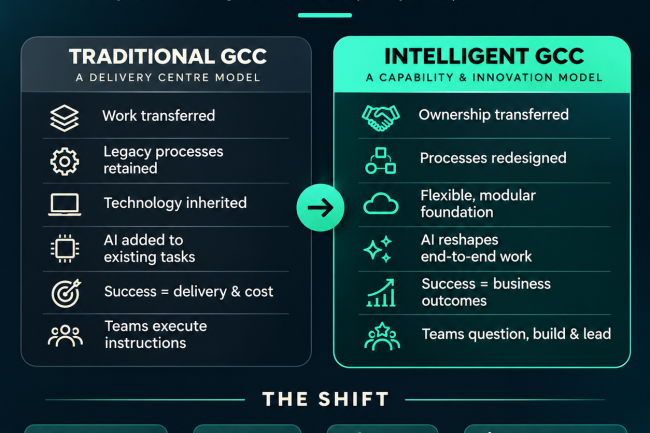
For years, India has been the preferred destination for global organisations looking to move technology, operations and business processes closer to talent and cost efficiencies. This has given rise to thousands of Global Capability Centres (GCCs).
But the question we should be asking today is: Are we building centres that simply do the work, or centres that rethink how the work should be done?
The traditional GCC model was largely built around a lift-and-shift approach. Take an existing process, move the people and technology to India, and continue delivering against the same expectations.
That model served its purpose. But with AI fundamentally changing how businesses operate, I believe it is time to rethink the model itself.
At Rohit Consultants, through our work with businesses on technology strategy, product development, AI adoption and digital transformation, this is a shift we increasingly see as necessary.
The next generation of GCCs needs to move beyond delivery efficiency towards what I would call Intelligent Transition — where technology, talent, processes and decision-making evolve together.
Here are six perspectives on what that transition should look like.
1. You can move the work, but can you move the freedom to innovate?
Imagine being handed the keys to a house and being asked to run a modern hotel inside it.
You can paint the walls, improve the service and keep the guests happy. But if the plumbing, wiring and layout are fundamentally flawed, growth will eventually hit a ceiling.
That is what happens when a GCC inherits technology without rethinking it.
The first few years may look like business as usual. Delivery continues, targets are met and operations run smoothly. But sooner or later, the team spends more time fixing yesterday’s decisions than creating tomorrow’s solutions.
You can move the work from one person to another overnight; you cannot move the freedom to innovate.
2. You cannot AI your way out of an organisational problem.
Imagine buying an expensive, fully automated machine for a factory where the raw materials are inconsistent, the process is broken and nobody is responsible for the final product.
Even the best machine can only do so much when everything around it is broken.
That is where many AI initiatives stumble. Organisations rush to adopt the latest models before fixing their data, understanding the problem or deciding who is accountable for the result.
AI is not a magic layer that you can put over an inefficient business and expect everything to improve.
You cannot AI your way out of an organisational problem.
3. AI-native is not about doing the same work faster. It’s about doing it differently.
The real difference is whether you are making an existing process faster or questioning why it exists in its current form.
Take software development. Giving developers AI tools to write code faster is useful. But what if AI could help take a business requirement through design, coding and testing with far fewer manual handoffs?
At Rohit Consultants, this is the shift we are exploring — rethinking how the entire process works, rather than optimising each step in isolation.
The opportunity isn’t just to do the same work faster; it’s to fundamentally rethink how the work gets done.
AI-native isn’t about adding AI to the process. It’s about redesigning the process with AI in mind from the start.
4. Don’t start with technology. Start with the business problem.
Having worked with businesses trying to bring AI into their day-to-day operations, I’ve realised that the first question shouldn’t be, “Where can we use AI?” but “What is slowing us down, and why?”
Sometimes the answer is better data, sometimes a broken process, and sometimes AI genuinely is the solution.
I’d start small, pick a real business problem, solve it properly and learn from the outcome before rolling it out further. The technology can evolve as you go, but the foundation needs to be flexible enough to support that change.
You don’t need to make every part of the business intelligent overnight. You need to know where to start, what to fix, and how to build from there.
5. Build problem-solvers, not just prompt operators.
I think we need to rethink what we look for when hiring engineers.
It’s easy to assess someone on how well they code or execute a task. But can they question the requirement, understand the business problem and figure out whether there’s a better way to solve it?
There’s a reason this matters. Stack Overflow’s 2026 Developer Survey found that 48% of technologists trust AI output only when they can easily verify it, while just 6.6% trust it for important work decisions.
That tells us something important. Knowing how to generate an answer is one skill; knowing whether it’s the right answer is another.
As AI takes on more routine work, we need engineers who can think critically, understand architecture and take responsibility for the outcome.
The goal should be to build problem-solvers, not just prompt operators.
6. The first 90 days: Give the GCC a seat at the table.
I’d spend the first 90 days making sure the GCC has a seat at the table, not just a place in the organisation chart.
The team must be close enough to the business to understand its real challenges, empowered to question the status quo, and accountable for outcomes — not just delivery.
I’d choose one high-impact business challenge and take it all the way to implementation, delivering something that solves a genuine problem and demonstrates measurable value, rather than another pilot that never makes it into everyday use.
Having the right people and technology matters, but culture and trust matter just as much.
If you transfer the work without transferring ownership, you’ve built a delivery centre, not a capability centre.
The bigger picture: From delivery centres to innovation centres
India’s GCC story is entering a very different phase.
The opportunity is no longer just about having access to a large engineering workforce or delivering global operations at a competitive cost. It is about building teams that understand the business, challenge existing thinking, experiment with new technologies and take ownership of outcomes.
AI will accelerate this transition, but technology alone won’t make it happen.
It will take a change in mindset from global leadership, a willingness to rethink established processes, investment in the right talent and, above all, the trust to let teams in India do more than execute instructions.
I believe the most successful GCCs of the next decade will not necessarily be the largest ones. They will be the ones that have the freedom and capability to question, build, experiment and lead.
The future of GCCs isn’t about how much work India can take on. It’s about how much of the future India can help build.
An independent practitioner perspective by Rohit D’Souza, Founder & CTO, Rohit Consultants.
Rohit Consultants works with businesses on technology strategy, AI adoption, digital product development and engineering transformation — helping organisations move from technology execution to meaningful business outcomes.